The 2026 AI Tools Tier List, Honestly Ranked
We ran 2026's most-hyped assistants, agents and copilots through real project work — not staged demos — and sorted them into tiers. Here is what earned an S, and what we would quietly avoid.
 Anna Keller · Senior AI & Machine Learning Engineer
8 min read
Fact-checked
Anna Keller · Senior AI & Machine Learning Engineer
8 min read
Fact-checked
Key takeaways
- A tier list is only useful if it reflects your work; ours is a starting point built from repeatable, real-task testing rather than vendor benchmarks.
- The S-tier is reserved for tools that save time after review — anything that needs heavy correction quietly loses the time it appeared to save.
- In-editor coding assistants with strong repository context were the most consistent value of 2026; standalone chat tools remain excellent thinking partners.
- The most expensive failure mode is confident-but-wrong output, so transparency and traceability matter as much as raw capability.
- Treat exact placements as a snapshot: re-run your own evaluation whenever a tool you depend on changes its underlying model.
Every January, a fresh wave of "best AI tools 2026" lists arrives, and most of them are indistinguishable from press releases. They rank tools by feature count, by funding round, or by how impressive the launch video looked. None of those things predict whether a tool will actually help you finish a Tuesday afternoon's work. So this year we did something less glamorous and more honest: we took the most-hyped assistants, agents and copilots and made them earn their place on real projects, doing the same kinds of tasks we do every week.
The format is a tier list — S down through the avoid pile — because tiers force a decision. A flat "here are 30 great tools" article is a cop-out; it tells you nothing about trade-offs. What we care about is the question buried inside every shortlist: which AI tools are worth it for the specific way you work, and which are flattering demos that fall apart on contact with a messy codebase or a real document. That distinction is the whole point of this AI tools tier list.
One thing up front. We are not going to pretend objectivity we do not have. Tooling is contextual, and a tool that is S-tier for a solo founder shipping a prototype may be B-tier for a regulated team that needs an audit trail. Where our judgment is subjective, we will say so. Where it rests on repeatable testing, we will show the method. If you want the broader picture of where the field stands, our companion piece on AI in 2026 and what every developer should actually know sets the scene; this article is the opinionated, results-first sequel.
How we tested and ranked
The fastest way to produce a misleading ranking is to judge tools by their demos. Demos are optimised — the prompt was rehearsed, the repository was clean, and the failure cases were edited out. We avoided that trap by defining a fixed battery of tasks and running every tool through the same ones, so differences in outcome reflected the tool rather than the prompt. This is the same discipline good engineering teams apply to any procurement decision, and it mirrors the structured approach we describe in how to choose the right software solution.
The tasks we used
Our battery had five recurring jobs. First, a non-trivial refactor of an existing module with real dependencies, not a toy function. Second, a genuine bug — the kind with a misleading stack trace — to see whether the tool reasons or pattern-matches. Third, a documentation task: turn a dense technical spec into something a new hire could read. Fourth, a data-shaping job that touched a real format, the sort of work covered in our guide to RTF to XML document conversion. Fifth, an open-ended "explain this unfamiliar system" prompt, because half the value of these tools is comprehension, not generation.
What we scored
We scored five dimensions: accuracy on the task, time saved after human review, reliability under repeated runs, transparency of reasoning and sources, and total cost including the hidden cost of cleanup. That fourth dimension matters more than people admit. A tool that is right 70% of the time but tells you which 30% to double-check is worth more than one that is right 85% of the time with serene, unjustified confidence. The confident-wrong failure mode is the one that erodes trust and, eventually, time.
From the bench. When we ran the same misleading-stack-trace bug across every tool three times each, the spread between runs was as revealing as the average. Two tools that looked equal on a single pass diverged sharply once we demanded consistency: one solved it cleanly all three times, the other invented a different plausible-sounding cause on each attempt. A pattern we keep seeing is that variance, not peak performance, is what separates a tool you can build around from one you have to babysit.
We deliberately weighted reliability and transparency because, in production, those are what let you trust a tool unsupervised. That priority aligns with the risk-based thinking in the NIST AI Risk Management Framework, which treats trustworthiness — not raw capability — as the property worth measuring. For a sense of how fast the underlying capabilities are moving year over year, the Stanford HAI AI Index is the most level-headed annual reference we know of, and we cross-checked our impressions against its trend data rather than against marketing claims.
S-tier: the tools worth building around
S-tier is narrow on purpose. To earn it, a tool had to save real time after review, stay reliable across repeated runs, and be transparent enough that we trusted it on work we could not fully re-verify ourselves. Capability alone was never sufficient; we have seen brilliant tools wash out of S-tier because they were unpredictable. The winners share a quieter virtue: they make you faster without making you anxious.
In-editor coding assistants with deep repository context
The most consistent S-tier value of 2026 came from coding assistants that live inside the editor and genuinely understand the whole repository, not just the open file. When these tools have real context, the loop between intent and working code collapses. They are strongest on the unglamorous middle of the job: completing a function you have already designed, propagating a rename across a codebase, or drafting tests that match existing conventions. This is exactly the territory where AI coding assistants compared head-to-head start to separate, and where context depth beats raw model size.
The caveat that keeps them honest is that they are accelerators, not architects. They will happily implement a bad design fluently. The teams getting the most out of them treat the assistant as a fast pair-programmer who never gets tired but also never owns the decision — a division of labour we explore further in putting AI at the core of your stack, carefully.
Frontier chat models as reasoning partners
The other clear S-tier entry is the best general-purpose chat model used as a thinking partner. Not for generating final code or final copy, but for the messy, ambiguous front of a problem: pressure-testing an approach, surfacing edge cases you missed, or explaining a subsystem you inherited. Here, the open-ended "explain this unfamiliar system" task is where these models shine, and where they comfortably out-earn their subscription cost for anyone who works with unfamiliar code or documents regularly.
Tip. Keep your S-tier list short and deliberately learn those tools deeply. Two tools you know intimately will outperform six you use shallowly. The compounding returns come from fluency — knowing exactly when to reach for the assistant and, just as importantly, when not to.
A-tier: strong, with caveats
A-tier tools are genuinely good and earn a place in most workflows, but each carries a caveat significant enough to keep it off the top shelf. These are the tools we recommend with a sentence of warning attached, because the warning is where the time goes if you ignore it.
Autonomous coding agents
Agentic tools that take a ticket and attempt the whole change — read the repo, plan, edit multiple files, run tests — made real progress in 2026. On well-scoped, well-tested tasks in a clean codebase, they are remarkable. The caveat is that their failure curve is steep: as task ambiguity rises, success drops faster than with an in-editor assistant, and a confidently wrong multi-file change is expensive to unwind. We keep them firmly in A-tier because they reward strong test suites and punish weak ones. If your codebase has thin coverage, an agent will expose that the hard way.
AI productivity tools for writing and research
For the "AI productivity tools ranked" crowd — note-takers, summarisers, meeting and research assistants — the best are solidly A-tier. They reliably save time on first drafts, transcription and synthesis. The caveat is verification: they are excellent at producing plausible structure and occasionally wrong details. For anything that will be quoted, cited or acted upon, treat their output as a confident intern's draft, not a finished product. Used that way, they are a genuine multiplier on knowledge work.
| Tool category | Tier | Best at | Main caveat |
|---|---|---|---|
| In-editor coding assistant | S | Fast, context-aware code | Accelerates bad designs too |
| Frontier chat / reasoning model | S | Ambiguous problem framing | Not a source of final truth |
| Autonomous coding agent | A | Well-scoped, well-tested tasks | Steep failure curve on ambiguity |
| Writing & research assistant | A | Drafts, summaries, synthesis | Needs fact verification |
| Niche / single-purpose tool | B | One job, done well | Narrow; easily duplicated |
| All-in-one "AI platform" | C / avoid | Impressive demos | Jack of all, master of none |
The pattern in this table is worth pausing on: the tools that rank highest do one thing exceptionally and stay honest about their limits. The ones that drift down the list are usually the ones that promise everything.
B-tier: useful in the right niche
B-tier is not an insult. It is where most genuinely useful, narrowly-scoped tools live. These are the single-purpose utilities that do one job well — a strong code-review bot, a specialised data-extraction tool, a focused accessibility checker, a translation or transcription engine tuned for a domain. They will not change how you work, but in their niche they are reliable and often better than a general tool asked to do the same job.
Why narrow can beat broad
A focused tool can encode domain knowledge a general model lacks. A purpose-built accessibility scanner, for instance, can enforce concrete rules far more dependably than a chat prompt — though, as we argue in our piece on the trouble with accessibility overlays, automated tooling has hard limits and cannot replace human judgement. The lesson generalises: narrow tools earn B-tier by being honest about scope, and the most useful ones cite the published research indexed on arXiv that defines where their automation actually stops.
The integration tax
The hidden cost of B-tier tools is integration. Each one is another login, another API key, another thing to monitor. A tool that saves ten minutes a week but takes an afternoon to wire up and a quarterly check-in to maintain may not clear the bar. This is the same total-cost-of-ownership calculation that governs any stack decision, and it is why we generally favour a small set of strong tools over a sprawling collection of clever ones. If you are weighing whether a capability belongs in-house or as a bolt-on, our overview of what exactly a software solution is frames the trade-off well.
Watch out. Tool sprawl is the silent killer of the B-tier. We have seen teams accumulate a dozen single-purpose AI tools, each justified on its own, until nobody can say what data flows where. Before adopting another niche tool, ask whether a tool you already run can do the job at 90% — usually it can, and the simplicity is worth the missing 10%.
The over-hyped and the avoid list
Some categories underdelivered relative to their marketing, and a few we would actively steer people away from. We are not naming and shaming individual products, because specific tools change faster than the categories they belong to; the patterns are more durable than any single brand.
The over-hyped "do-everything" platform
The clearest over-hype of 2026 was the all-in-one AI platform that promises to write your code, run your marketing, answer your support tickets and manage your calendar. In testing, these were jacks of all trades and masters of none. Each module was outperformed by a focused tool, and the supposed benefit of integration rarely materialised because the modules did not actually share useful context. The demo is dazzling; the daily reality is mediocrity in five directions at once.
Tools that hide their reasoning
We are wary of any tool that produces consequential output with no traceable reasoning and no way to inspect what it relied on. For a casual task that is fine. For anything that touches code, money, compliance or user-facing content, opacity is a liability. The trustworthiness properties set out in the NIST AI Risk Management Framework — explainability, accountability, the ability to contest an output — are exactly what these tools lack, and that is why they sit near the bottom regardless of how capable they seem.
"AI" that is a thin wrapper
Finally, the avoid pile contains tools that are little more than a thin interface over a model you could call directly, sold at a premium for a feature you can replicate in an afternoon. The tell is that they add no real workflow, no domain knowledge and no data of their own — only branding. If a tool's entire value is a prompt and a logo, you are paying a markup for convenience you may not need. Understanding the underlying layers, as covered in system, application and programming software explained, makes these wrappers easy to spot.
Choosing tools for your own workflow
A tier list is a map, not the territory. The genuinely useful exercise is building your own list, because the right answer depends on what you actually do all day. Here is the process we recommend, and the one we used ourselves.
Start from your real tasks, not the hype
Write down the five things you spend the most time on this month. Then ask, task by task, whether a tool meaningfully shortens that work after review. If you cannot point to a concrete task a tool improves, you do not need it yet — no matter how high it sits on someone else's "best AI tools 2026" list. This task-first framing is the same one that keeps web projects grounded, as we discuss in web development fundamentals, clearly explained.
Measure time saved after review, honestly
The number that matters is net time saved, counting the time you spend checking and fixing the tool's output. Run a tool on real work for a week and track it. Many tools that feel fast turn out to be neutral once you account for review; a few quietly save hours. Only the measured ones earn a place. Performance discipline like this is the same instinct good teams bring to modern web development and design, where measured outcomes such as Core Web Vitals beat gut feeling every time.
Mind cost, lock-in and data
Three practical filters separate good adoptions from regrettable ones. Cost: does the paid tier earn its keep at your usage? Lock-in: how hard is it to leave if the model degrades or pricing changes? Data: where does your input go, and are you comfortable with that? For content-heavy teams, these questions overlap with platform choices we cover in six real benefits of a modern CMS and the taxonomy in WCMS, DAM and ECM decoded. And if your AI tooling is pushing you toward heavier local hardware, our look at all-in-one PCs as developer workstations may help.
The 2026 tier list at a glance
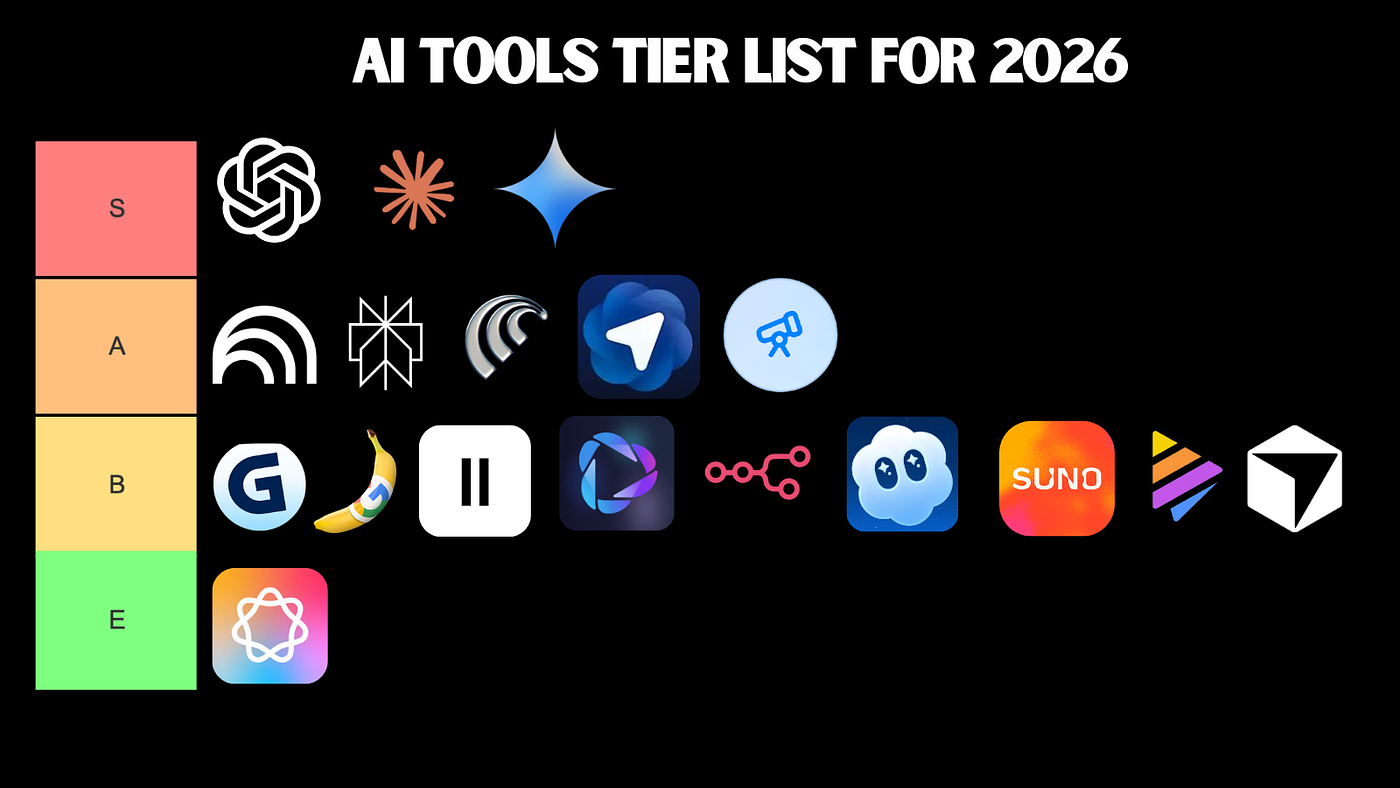
To pull it together: S-tier belongs to in-editor coding assistants with deep repository context and to frontier chat models used as reasoning partners — both save real time after review and stay reliable enough to trust on work you cannot fully re-verify. A-tier holds autonomous coding agents and the best writing-and-research assistants, each excellent within scope and each carrying a caveat worth respecting. B-tier is the home of strong, narrow, single-purpose tools that earn their place in a specific niche without trying to be everything.
The over-hyped and avoid pile is defined by three patterns: do-everything platforms that master nothing, opaque tools that hide their reasoning where transparency matters, and thin wrappers that add branding rather than value. Notice that none of those failures are about raw capability — they are about reliability, transparency and honest scope. That is the throughline of the entire 2026 list.
If you take one thing from this AI tools tier list, let it be the method rather than the placements. Models will leapfrog each other, a B-tier tool may ship an update that vaults it to A, and an S-tier favourite may stumble when it swaps its underlying model. The durable skill is the evaluation itself: test on your own work, measure time saved after review, distrust the polished demo, and re-check when anything you depend on changes. Do that, and you will not need next January's hype cycle to tell you which AI tools are worth it — you will already know. Browse the rest of our writing on the Logictran home page or the full articles index, and if you want to know who is behind these reviews, the about the journal page lays out our standards.
Frequently asked questions
What is the best AI tool for developers in 2026?
There is no single winner. For day-to-day coding, a strong in-editor assistant with good repository context tends to deliver the most value, because it shortens the loop between intent and working code. The best tool is the one that fits your stack, respects your review process, and stays out of the way when you already know the answer.
Are paid AI tools worth it over free ones?
Often, but not always. Paid tiers usually buy you larger context, faster responses, and stronger models, which compound across a working day. If you use a tool for more than an hour a day on real tasks, the subscription typically pays for itself. For occasional use, capable free tiers are now good enough to skip the upgrade.
How do you objectively rank AI tools?
We avoid cherry-picked demos and run tools through repeatable real tasks: the same refactor, the same bug, the same document. We score on accuracy, time saved after review, reliability under load, transparency, and cost. We also weigh how often the tool produces confident but wrong output, since that failure mode quietly costs the most time.
Will this tier list still be accurate next year?
Partly. Individual rankings shift as vendors ship new models, so treat exact placements as a snapshot. The method, however, ages well: test on your own work, measure time saved after review, and distrust polished demos. Re-run the evaluation when a tool you depend on changes its model, and you will rarely be surprised.
Sources & further reading
- NIST AI Risk Management Framework — the U.S. National Institute of Standards and Technology's framework for trustworthy AI, emphasising explainability, reliability and accountability over raw capability.
- Stanford HAI — AI Index — Stanford's Institute for Human-Centered AI, home of the annual AI Index, a level-headed source for year-over-year trends in AI capability and adoption.
- arXiv — AI research preprints — the open repository of preprint research papers where much of the primary work on AI evaluation and limitations is first published.

.jpeg)
.jpeg)